Sourcing Amaranth Seeds from India: A Complete Guide for International Buyers
Sourcing Amaranth Seeds from India: A Complete Guide for International Buyers
India has established itself as an important sourcing destination for a wide range of agricultural commodities, including traditional grains, specialty seeds and emerging food ingredients. Among these, amaranth seeds have gained attention in international ingredient markets, creating opportunities for importers, food processors, distributors and bulk commodity traders.
Known in India as Rajgira or Ramdana, amaranth is traded in different varieties and grades, depending on its intended application and quality requirements.
However, sourcing amaranth internationally involves more than identifying a supplier and negotiating a price. Buyers must evaluate product specifications, origin, cleaning standards, testing procedures, packaging, export documentation and destination-country regulations.
This guide explains the important considerations when purchasing bulk amaranth seeds from India and how international buyers can establish a reliable sourcing arrangement.
1. Understanding Amaranth: The Product Behind the Trade
Amaranth belongs to the genus Amaranthus and is cultivated for its small edible seeds. Although frequently grouped with grains, it is botanically classified as a pseudocereal.
In the Indian market, amaranth is commonly known by several names:
| Trade Name | Common Market Reference |
|---|---|
| Amaranth Seeds | International trade terminology |
| Rajgira | Widely used Indian name |
| Ramdana | Common Indian market name |
| Amaranth Grain | Food ingredient and grain trade terminology |
Different amaranth species are commercially cultivated, including Amaranthus cruentus and Amaranthus hypochondriacus. Amaranthus caudatus is another species encountered in amaranth grain markets.
Types and appearance
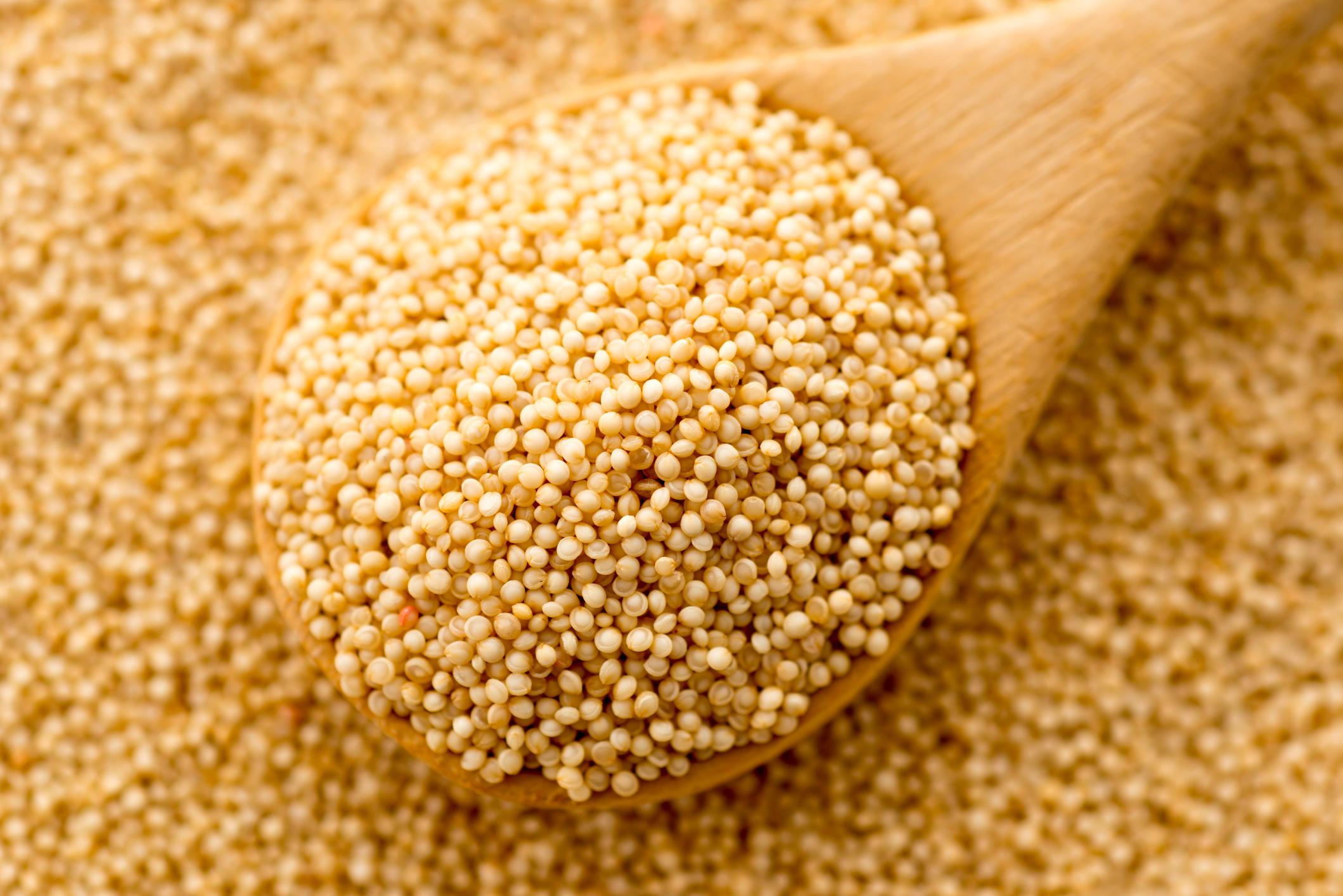
Amaranth seeds are available in different colours, with white and brown varieties commonly encountered in commercial sourcing.
White and brown amaranth seeds — buyers should confirm the required variety, colour and botanical identity.
When purchasing in bulk, buyers should specify the required seed colour, botanical identity and intended application rather than relying exclusively on the general term "amaranth".
Food-grade amaranth versus sowing seeds
An important distinction in international procurement is the difference between seeds intended for human consumption and those intended for agricultural propagation.
Buyers should clearly specify:
- Food-grade whole amaranth seeds.
- Intended for human consumption.
- Not intended for sowing or propagation.
- Required variety and colour.
- Applicable quality and safety parameters.
Amaranth flour is a separate processed product and should be quoted independently from whole seeds.
2. Why Consider India for Bulk Amaranth Procurement?
India offers international buyers access to an established agricultural trading ecosystem, supported by farming networks, commodity aggregators, processors and exporters.
For importers, sourcing from India can offer several commercial advantages:
Established agricultural supply networks: India has a broad network of agricultural producers, traders and sourcing companies that facilitate the procurement of specialty grains and seeds.
Product variety: Buyers can enquire about different amaranth varieties and specifications depending on availability and market requirements.
Flexible procurement arrangements: Depending on the supplier, buyers may explore trial quantities, bulk orders and different packaging configurations.
Export-oriented supply chain: Indian exporters and sourcing partners can coordinate quality checks, export documentation and international shipment arrangements.
Competitive commercial opportunities: Product origin, crop availability, procurement arrangements, processing requirements and shipment volumes all influence the final offer.
What should buyers evaluate when selecting India as an origin?
| Procurement Consideration | What to Establish |
|---|---|
| Product availability | Variety, colour and available quantity |
| Crop origin | Agricultural sourcing region and crop year |
| Quality consistency | Agreed specifications and inspection procedures |
| Processing | Cleaning, grading and sorting arrangements |
| Commercial terms | Price, MOQ and shipment frequency |
| Export readiness | Documentation and logistics coordination |
The most important consideration is not simply the country of origin, but the supplier's ability to consistently meet the buyer's agreed requirements.
3. Amaranth Seed Quality: Specifications Every Importer Should Know
Product specifications form the foundation of a successful agricultural commodity transaction.
Two suppliers may quote amaranth seeds at similar purity levels but offer different products in terms of moisture, foreign matter, damaged seeds, contamination controls and laboratory testing.
International buyers should therefore establish a written specification before requesting commercial quotations.
Essential quality parameters
| Quality Parameter | What Buyers Should Specify | Commercial Importance |
|---|---|---|
| Variety and identity | Botanical name and seed type | Ensures the correct product is supplied |
| Colour | White, brown or other agreed variety | Maintains visual consistency |
| Purity | Required percentage and test method | Determines usable product content |
| Foreign matter | Maximum permissible percentage | Reduces unwanted material |
| Other seeds | Permissible admixture | Helps control cross-contamination |
| Stones and impurities | Maximum permitted level | Important for processing and food safety |
| Moisture | Maximum percentage at loading | Helps maintain storage stability |
| Broken seeds | Maximum permissible percentage | Influences appearance and processing yield |
| Damaged seeds | Maximum permissible percentage | Indicates product condition |
| Infestation | Agreed live-insect and infestation limits | Helps prevent shipment and storage problems |
| Microbiological parameters | Applicable testing panel | Supports intended food applications |
| Pesticide residues | Destination-specific MRL requirements | Supports regulatory compliance |
| Heavy metals and mycotoxins | Applicable destination limits | Helps establish product safety |
A specification should include three things: the acceptable limit, the testing method and the sampling procedure.
A statement such as "99% purity" alone is insufficient to establish the complete quality of a shipment.
Why cleaning and grading matter
Commercial amaranth seed preparation may involve multiple cleaning and sorting stages, depending on the incoming raw material and buyer's requirements.
Typical operations to discuss with a supplier include:
- Pre-cleaning to remove larger unwanted material.
- De-stoning to separate stones and heavier impurities.
- Screening and grading to improve uniformity.
- Gravity separation where required to remove density-based impurities.
- Optical sorting where available and appropriate.
- Final inspection before packing.
Cleaning and grading operations help suppliers meet agreed product specifications.
Buyers should ask which processes are conducted in-house, which are outsourced and how the processed lot is identified and inspected before dispatch.
4. Laboratory Testing and Quality Verification
For international buyers, a supplier's quality assurance process should extend beyond visual inspection.
A representative sample and a corresponding Certificate of Analysis (COA) help establish whether the product meets the agreed specification.
Important testing and verification requirements
| Test / Verification | Purpose |
|---|---|
| Moisture analysis | Checks moisture content against the agreed limit |
| Purity analysis | Establishes the proportion of acceptable seeds |
| Foreign matter analysis | Measures unwanted material |
| Pesticide residue testing | Checks compliance with destination-market limits |
| Heavy metal analysis | Verifies applicable food-safety requirements |
| Microbiological testing | Evaluates relevant microbial parameters |
| Mycotoxin testing | Checks applicable contamination risks |
| GMO declaration | Provides the required product-status information |
| Irradiation declaration | Addresses buyer or market requirements |
The exact testing panel should be agreed according to the destination country, intended application and buyer's quality standards.
What should an importer verify in a COA?
Before accepting a laboratory report, check:
- Product description and identification.
- Lot or batch number.
- Sampling and testing dates.
- Laboratory identity.
- Test methods used.
- Results and measurement units.
- Reporting limits or limits of quantification.
- Compliance with the agreed specification.
A laboratory report should relate to the actual lot being offered, rather than being treated as a generic certificate for every shipment.
5. Processing, Storage and Bulk Packaging
Proper handling after procurement is important for maintaining the condition of amaranth seeds throughout the supply chain.
Buyers should establish how the product is cleaned, stored and packed before shipment.
Common export packaging options
| Packaging Format | Typical Commercial Use | Buyer Considerations |
|---|---|---|
| 25 kg PP bags | Bulk ingredient distribution | Food-contact suitability, liner and labelling |
| 50 kg PP bags | Commercial wholesale supply | Handling, stitching and moisture protection |
| 1 MT jumbo bags | Large-volume industrial procurement | Loading equipment and handling requirements |
| Retail packs | Consumer distribution | Artwork, labelling and destination regulations |
Packaging formats and handling requirements should be agreed before order confirmation.
Packaging should be mutually agreed before order confirmation. Buyers should also specify whether they require inner liners, palletisation, specific bag materials or private-label packaging.
Storage and handling considerations
Amaranth seeds should be stored under appropriate conditions to protect their quality during warehousing and transportation.
Important considerations include:
- Maintaining appropriate moisture levels.
- Preventing exposure to water and excessive humidity.
- Using clean, dry storage areas.
- Protecting bags from pests and contamination.
- Ensuring proper lot identification.
- Avoiding direct contact with unsuitable storage surfaces.
Storage conditions and moisture specifications should be agreed with reference to the product's intended shelf life and transportation conditions.
6. Minimum Order Quantity and Commercial Pricing
The commercial structure of an amaranth seed purchase depends on several factors. There is no universal minimum order quantity applicable to every Indian supplier.
MOQ can vary according to the product grade, crop availability, packaging format, processing requirements and transportation arrangement.
Factors influencing bulk amaranth prices
| Pricing Factor | Its Influence on the Quotation |
|---|---|
| Product variety | Different seed types may have different market values |
| Purity and grade | Higher specifications may require additional processing |
| Conventional / organic status | Certification and sourcing requirements affect pricing |
| Crop year | Availability and crop conditions influence procurement |
| Processing requirements | Additional cleaning and sorting may affect costs |
| Order quantity | Larger volumes may offer different commercial economics |
| Packaging | Bag type, liner and palletisation influence costs |
| Certifications and testing | Additional verification may add to the price |
| Incoterms | Determines the division of freight, insurance and delivery responsibilities |
| Payment terms | Influences the overall commercial arrangement |
Common international trade terms
Buyers may request quotations on different delivery bases:
- EXW: Goods made available at the seller's premises.
- FCA: Delivery to the agreed carrier or location.
- FOB: Seller delivers goods on board the vessel at the named port.
- CFR: Seller arranges and pays the freight to the named destination port.
- CIF: Seller arranges freight and the required insurance to the named destination port.
The appropriate Incoterm depends on the shipment arrangement. Buyers and suppliers should always specify the named place or port and the applicable Incoterms edition.
For containerised cargo, FCA, CPT or CIP may be more suitable than traditional port-based terms, depending on the logistics arrangement.
7. Export Documentation for Indian Amaranth Shipments
International agricultural commodity shipments require appropriate documentation for customs clearance, food-safety verification and plant-health requirements.
The exact document set depends on the importing country, product classification, shipment arrangement and any additional buyer requirements.
Common export documents
| Document | Purpose |
|---|---|
| Commercial Invoice | Records the transaction value and commercial details |
| Packing List | Provides package-wise shipment information |
| Bill of Lading | Transport document for sea shipments |
| Certificate of Origin | Establishes the declared country of origin |
| Phytosanitary Certificate | Addresses applicable plant-health requirements |
| Certificate of Analysis | Provides product quality and laboratory results |
| Fumigation Certificate | Evidence of fumigation when required or performed |
| Insurance Certificate | Provides evidence of cargo insurance where applicable |
| Pre-shipment Inspection Report | Records agreed independent inspection results |
| Organic Documentation | Supports certified organic claims where applicable |
Indian plant-product exports may involve procedures administered by the Directorate of Plant Protection, Quarantine & Storage.
Importers should confirm whether a phytosanitary certificate, additional declaration, treatment or other plant-health documentation is required for their particular shipment.
Export documents and plant-health requirements depend on the destination market and shipment.
8. Destination-Market Requirements: What International Buyers Should Check
Food import regulations differ between countries. A shipment accepted in one market may require additional testing, declarations or documentation in another.
The importing company should verify the applicable requirements before finalising the purchase contract.
| Destination Market | Important Areas to Verify |
|---|---|
| United States | FDA food-facility registration where applicable, Prior Notice, importer FSVP responsibilities and relevant food-import requirements |
| European Union | Applicable pesticide MRLs, food-safety requirements, contaminants and organic import procedures where relevant |
| United Kingdom | Applicable food-import, pesticide-residue, plant-health and customs requirements |
| Other International Markets | Local food-safety legislation, customs classification, plant quarantine and import permits |
Additional requirements for specific claims
Organic: Buyers requiring organic amaranth should verify the supplier's current certification, product scope, certifier and shipment-specific documentation. Organic status should never be assumed from the product's country of origin.
Gluten-free: Where a gluten-free claim is required, buyers should establish segregation, cross-contact prevention and appropriate analytical testing. The Codex reference threshold for a gluten-free claim is below 20 mg/kg.
Non-GMO: Any non-GMO declaration or certification should be supported by the documentation required by the buyer.
The final responsibility for establishing import eligibility should be coordinated with the relevant destination-country authorities and the importer's customs or regulatory adviser.
9. How to Identify a Reliable Amaranth Seed Supplier in India
Finding a supplier is relatively straightforward. Finding one capable of maintaining product consistency, meeting documentation requirements and communicating effectively throughout the transaction is considerably more important.
International buyers should evaluate suppliers across several areas.
| Evaluation Criteria | Questions Worth Asking |
|---|---|
| Business credentials | Is the supplier a registered business with valid export credentials? |
| Supply chain | Does it source directly, aggregate or purchase from other processors? |
| Processing capability | Where and how are the seeds cleaned and graded? |
| Traceability | Can the supplier identify and track individual lots? |
| Laboratory facilities | Which laboratory conducts the required tests? |
| Quality documentation | Can it provide lot-specific COAs and supporting reports? |
| Export experience | Has it handled shipments to the intended destination? |
| Samples | Can a representative sample be supplied before an order? |
| Inspection | Is independent pre-shipment inspection possible? |
| Complaint handling | What happens if the delivered goods do not meet the agreed specification? |
Questions to ask before confirming an order
- Which crop year does the offered material belong to?
- What is the available quantity of the required variety?
- What is the moisture content at the time of loading?
- Which cleaning and sorting processes are performed?
- Can the sample be linked to the actual shipment lot?
- Which laboratory conducts pesticide residue testing?
- Can the supplier meet the destination country's applicable MRLs?
- What is the proposed MOQ and packaging configuration?
- Which export documents can be provided?
- Can a third-party inspection be arranged before dispatch?
A transparent supplier should be able to discuss these points clearly before the buyer commits to a commercial order.
10. How to Prepare an Effective RFQ for Amaranth Seeds
A Request for Quotation (RFQ) should contain enough information for an Indian exporter to provide an accurate and commercially comparable offer.
An incomplete enquiry often leads to repeated communication, inconsistent quotations and misunderstandings about product specifications.
Recommended RFQ format
| RFQ Requirement | Information to Provide |
|---|---|
| Product | Food-grade whole amaranth seeds |
| Variety | Required botanical type and colour |
| Specification | Purity, moisture, foreign matter and other parameters |
| Quantity | Trial quantity and/or recurring monthly or annual requirement |
| Packaging | 25 kg, 50 kg, jumbo bags or other requirements |
| Destination | Country and destination port |
| Intended application | Food processing, distribution or wholesale |
| Certification | Conventional or certified organic, as required |
| Testing | Required laboratory parameters and residue limits |
| Delivery terms | Preferred Incoterm and named destination |
| Documentation | Required export certificates and supporting reports |
| Payment | Preferred payment arrangement |
| Inspection | Independent inspection requirements, if any |
Example of a buyer enquiry
An international buyer can structure an enquiry as follows:
"We are interested in sourcing food-grade whole white amaranth seeds from India for commercial distribution in our market. Please share your available specifications, current crop details, MOQ, packaging options and indicative quotation on FOB and CIF basis. Kindly also provide the available COA, applicable export documentation and sample availability."
Providing this information at the beginning helps suppliers prepare more relevant quotations.
11. Sample Approval and Pre-Shipment Inspection
A sample approval process should be treated as an essential stage of bulk agricultural procurement.
The sample must represent the product that the supplier intends to ship.
A recommended procurement sequence is:
Step 1 – Initial Enquiry: Buyer shares the required variety, grade, quantity and destination.
Step 2 – Specification Confirmation: Both parties agree on the technical parameters and acceptable tolerances.
Step 3 – Sample Submission: Supplier provides a representative sample for evaluation.
Step 4 – Laboratory Verification: Buyer checks the sample against the agreed specification.
Step 5 – Commercial Confirmation: Both parties finalise pricing, packing, payment and shipment terms.
Step 6 – Pre-Shipment Inspection: The goods are inspected and tested as agreed before dispatch.
Step 7 – Shipment and Documentation: Supplier coordinates loading and the agreed export documents.
Step 8 – Arrival Verification: Buyer compares the received shipment with the contractual specification and agreed inspection records.
A structured procurement process helps align specifications, samples, inspection and shipment.
Buyers should also retain a properly identified counter-sample to support future quality discussions or potential disputes.
12. Why Work with an India-Based Amaranth Sourcing Partner?
International agricultural procurement involves several moving parts: understanding local markets, coordinating with suppliers, establishing quality requirements, arranging testing, preparing documents and managing shipments.
An India-based sourcing partner can help international buyers coordinate these activities closer to the origin of production.
For importers who do not maintain a direct procurement presence in India, a reliable local partner can provide assistance with:
- Product availability and sourcing coordination.
- Supplier and processing arrangements.
- Quality specification alignment.
- Sampling and laboratory coordination.
- Packaging requirements.
- Export documentation.
- Shipment and logistics coordination.
- Communication throughout the procurement process.
The objective is to establish a sourcing relationship built on transparent specifications, reliable communication and mutually agreed commercial terms.
13. Source Amaranth Seeds from India with Fresh Farm Traders
At Fresh Farm Traders, we work in the bulk agricultural commodities and specialty ingredients trade, connecting Indian agricultural supply with international market requirements.
Our product portfolio includes superfood grains and specialty seeds, along with other agricultural ingredients.
Amaranth is an important product category for buyers exploring Indian-origin specialty grains for wholesale distribution, ingredient sourcing and food manufacturing.
We understand that international procurement requires more than an attractive quotation. Product specifications, quality expectations, sourcing arrangements, packaging and timely coordination all play an important role in establishing a successful supply relationship.
Whether you are a food ingredient importer, commodity distributor, wholesaler or manufacturer, we welcome enquiries for your amaranth seed requirements.
Looking to source bulk amaranth seeds from India?
Share your required variety, specifications, quantity, packaging preferences and destination port with our team.
Let's discuss your sourcing requirements and explore a suitable supply arrangement.
Fresh Farm Traders
Trade Built on Understanding and Relationships.
Frequently Asked Questions About Sourcing Amaranth Seeds from India
1. What is amaranth called in India?
Amaranth is commonly known as Rajgira or Ramdana in India. These names are widely used in domestic agricultural and food markets.
2. Can I purchase amaranth seeds in bulk from India?
Yes. Indian agricultural suppliers and exporters can cater to bulk procurement requirements. Available quantities, grades and MOQ depend on the supplier and crop availability.
3. What varieties of amaranth seeds are available?
White and brown amaranth seeds are commonly encountered in the market. Buyers should confirm the botanical identity, colour and actual availability with their supplier.
4. What purity should I request when purchasing amaranth?
Purity should be established according to the buyer's intended application and processing requirements. Buyers should specify the percentage, test method and acceptable foreign matter levels.
5. What is the usual packaging for bulk amaranth seeds?
Common commercial formats include 25 kg and 50 kg PP bags. Jumbo bags and other formats may also be available depending on the supplier.
6. Can I obtain a Certificate of Analysis before placing an order?
Buyers should request the available product specification and laboratory documentation. For final approval, the COA should correspond to the actual production or shipment lot.
7. Are organic amaranth seeds available from India?
Organic amaranth may be available through certified suppliers. Buyers should verify the current certification scope and shipment-specific organic documentation before placing an order.
8. Which export documents are required for amaranth seeds?
Common documents include a commercial invoice, packing list, bill of lading, certificate of origin, COA and applicable phytosanitary documentation. Additional requirements depend on the destination market.
9. What determines the price of Indian amaranth seeds?
Pricing depends on product variety, grade, purity, crop availability, processing, certification, packaging, order quantity and delivery terms.
10. How can international buyers request a quotation?
Buyers can contact an Indian supplier with their required variety, quality specification, quantity, packaging and destination port to obtain a relevant commercial offer.
Ready to Discuss Your Amaranth Sourcing Requirements?
Indian-origin amaranth seeds can be an interesting addition to an importer's specialty grain portfolio. The right sourcing arrangement begins with clear specifications, transparent communication and an understanding of the buyer's market.
Contact Fresh Farm Traders to discuss your bulk amaranth seed requirements from India.